In the world of place-based work, several terms are often used interchangeably to capture the element of ‘here’ or ‘location’ that all this work ultimately connects back to: ‘area’, ‘place’, ‘space’, ‘neighbourhood’, ‘locality’ and ‘community’.
Area-based initiatives, place-based programmes, spatial policy, neighbourhood interventions, locality working and community-focussed approaches do have some common ground: they are fundamentally designed to be situated or focused somewhere – to have an impact within some kind of micro- or meso-level geographical bounds. That’s a uniting feature, and is not the case for all policies and programmes.
But the various terms used to describe area-based work do not all have the same meaning. There is one conceptual distinction that matters in particular, and has useful practical implications, but is often ignored: the distinction between ‘space’ and ‘place’.
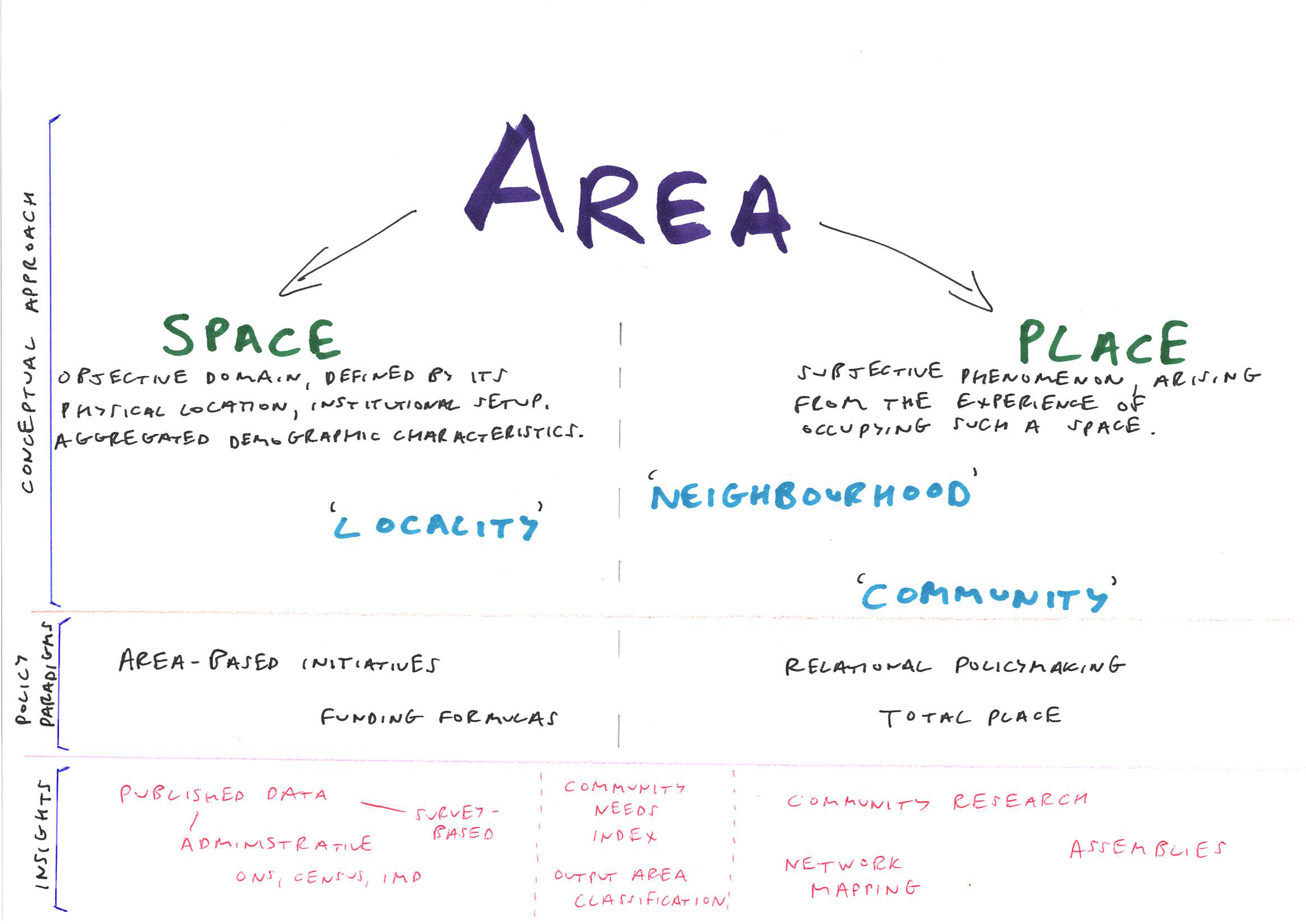
Boiling down much careful thinking by academics like Doreen Massey, Ruth Lupton and Nigel Thrift: ‘space’ captures the objective constellation of assets, services and agencies in a given area, while ‘place’ captures the subjective orientations that people living in that space have towards it; their experience of interacting with it.
There is a clear difference between area-based approaches treating area as ‘space’ and those treating area as ‘place’.
If we invoke this distinction, there is a clear difference between area-based approaches treating area as ‘space’ and those treating area as ‘place’. Broadly speaking, on one hand we have area as space / locality. And on the other hand we have area as place / neighbourhood / community. I’ve written elsewhere how the history of (not overly-successful) area-based initiatives in education is almost entirely space-based: little more than area-based targeting on the basis of outcomes.
On the other hand, the rapid spread of relational policymaking and collective impact initiatives clearly roots into the idea of ‘place’: co-designing policies with communities, based on their understanding of local forms of provision and support and what they need to look like instead – rather than the more traditional (space-based) needs assessment used to design state delivery.
There is room for both ‘space’ and ‘place’ in effective area-based work – one can complement the other in sequence. But it helps to know which mode we’re working in. I am currently working with a collective impact initiative who use a carefully designed process to direct their initial engagement with their locality. At first, this primarily looks at the local area as a ‘space’ – an objective catalogue of the assets and services present in the local area – but this rapidly evolves into something imbued much more heavily with notions of ‘place’: parents’ perceptions of those services; how they use them; the barriers they face to accessing them; the quality of relationships between those commissioning and delivering services, the way they understand and talk about the locality and the vision they have for it.
Genuinely place-based working can be far more responsive and powerful, because it takes a holistic view of the mechanisms behind people’s interactions and outcomes.
Why it matters: genuinely place-based working can be far more responsive and powerful. That’s because it stands a much better chance of understanding how people really feel about the areas they live in, engaging with the barriers they face in their lives and harnessing and building the assets and capabilities they want to develop – such as the networks of social capital people are part of. That can lead to far more effective models of service delivery, which take a holistic view of the mechanisms behind people’s interactions and outcomes (such as their worries, motivations and aspirations).
As we see the rollout of the Pride in Place Programme, the Neighbourhood Health Service and the return of Total Place (place-based budgeting), it’s looking hopeful that area-based policymaking is shifting into a new era that’s genuinely place-based, and not just mislabeled as such.
===
Here’s my longer-form take on the distinction between ‘space’ and ‘place’:
‘Space’ and ‘place’ represent, as concepts, different approaches to understanding the notion of ‘area’. Whereas space is regarded “as a dimension within which matter is located” (Agnew 2011: 316), place is “a distinctive coming together in space” (ibid: 317); it is seen to have a different set of characteristics that make it conceptually distinct. If space is an objective domain defined by its physical location alongside characteristics such as its labour market composition, institutional setup and aggregated demographic attributes, then place is a subjective phenomenon arising from the experience of occupying such a space. As Thrift states, “the difference between location and place is that places have meanings for us which cannot be reduced to their location” (1997: 160). In a similar vein, Massey sees places as “articulated moments in networks of social relations and understandings” (1993: 67). Hence the need, if we want to gain an understanding of a place, to analyse “the particularity of the social interactions which intersect at that location and of what people make of them in their interpretations and in their lives” (Massey 1994: 117).