This week the DfE published Early Years Foundation Stage Profile (EYFSP) results for the cohort of children finishing Reception in summer 2026. This marks the first major milestone on the path towards the government’s 75% GLD target, which it aims to hit in summer 2028.
At face value, the picture is positive. Nationally, 72.3% of children achieved a good level of development. This is up 4 percentage points on last year; a much bigger increase than we’re used to seeing year-to-year, and an uptick which – if replicated next year – will see the government meet its target a year early.
There’s insufficient evidence at this stage that this significant increase in the proportion of children achieving GLD is due to the renewed focus on and investment in the early years under the umbrella of Best Start in Life. This strategy was launched in July 2025, when LAs received individual GLD targets to be met by summer 2028, linked to the new Local Outcomes Framework. But the primary delivery vehicle for these demanding targets – the Best Start Family Hubs (BSFH) & Healthy Babies Programme – only kicked off in April 2026, when LAs published their Best Start Local Plans. Some of the GLD uptick this year may well be the result of renewed investment and focus under BSiL, and existing work local early years partnerships have been putting in place regardless of wider policy movement. But the uptick could equally reflect the previous government’s investment in an initial wave of Family Hubs in 75 LAs, which came online in 2024 – and have since been expanded to all remaining LAs under Labour.
~
LAs’ individual 2028 targets vary widely. Some areas, such as Manchester, have targets below 70% while some, such as Hampshire and North Yorkshire, have targets around 80%. This reflects LAs’ different starting points, which are highly uneven and correlate strongly with levels of deprivation.
In general, LAs with lower starting points (and therefore lower 2028 targets) have seen larger increases in their GLD figures this year. There is a moderate negative correlation between an LA’s 2024/25 GLD and its change in GLD between 2024/25 and 2025/26. This is what we’d expect to see, as LAs starting from a lower baseline have more headroom for improvement.
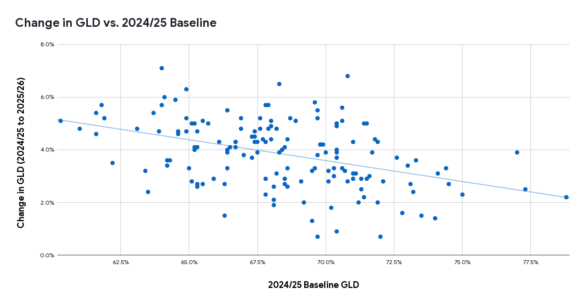
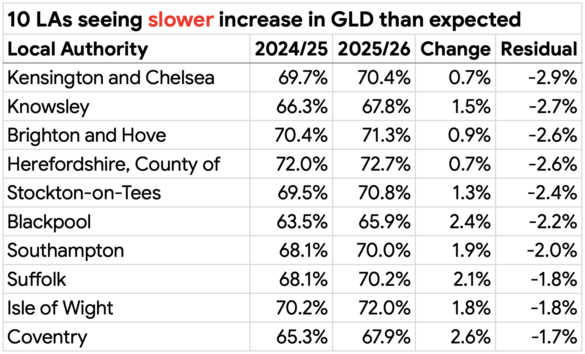
While many LAs sit close to the trendline – achieving an increase in GLD this year broadly in line with what we would expect, given last year’s baseline – many do not. In the data we can see LAs significantly below the trendline, whose GLD increases this year were relatively modest, given their starting point:
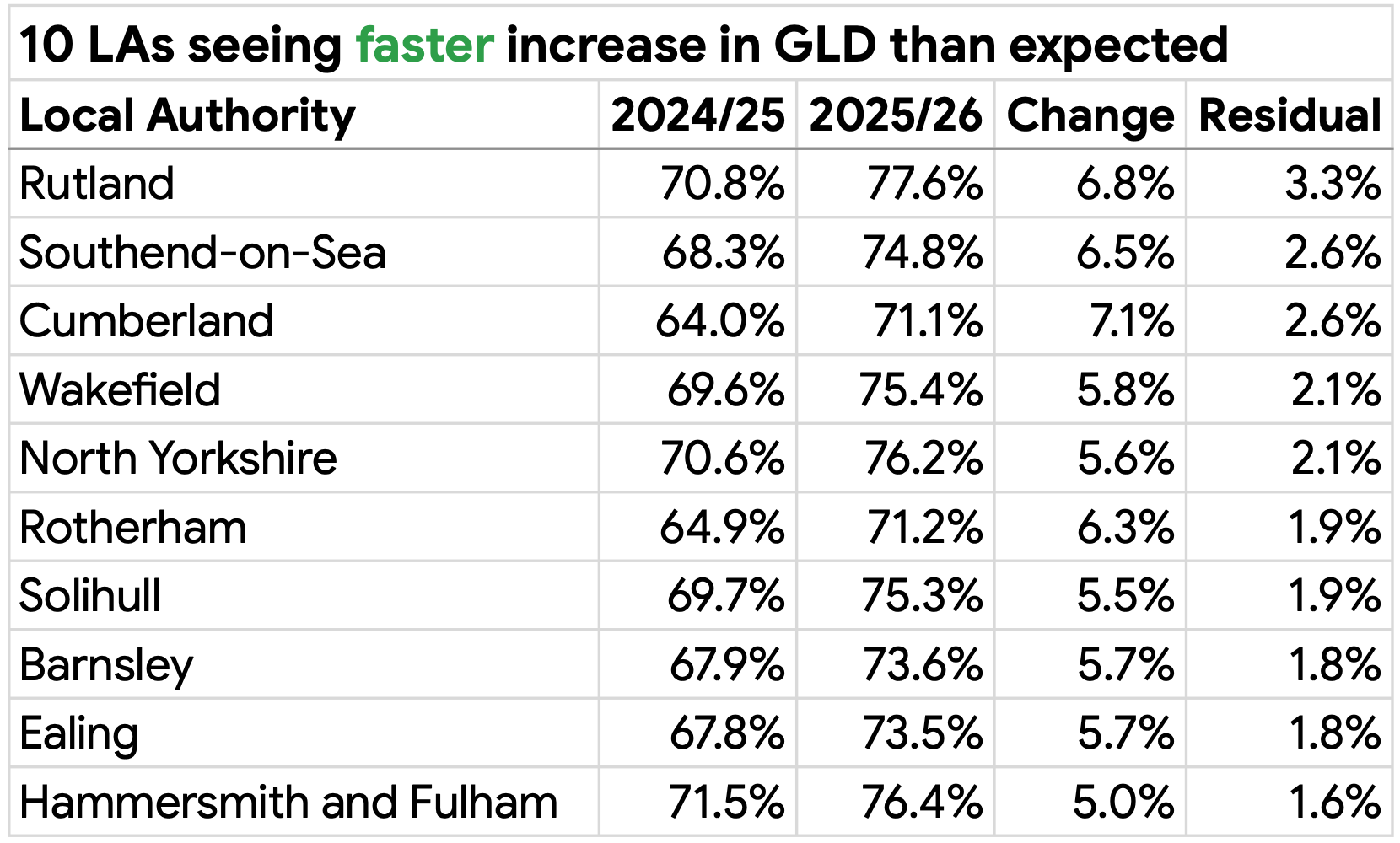
Meanwhile, we can also see LAs significantly above the trendline, whose GLD increases this year were larger than we’d have expected:
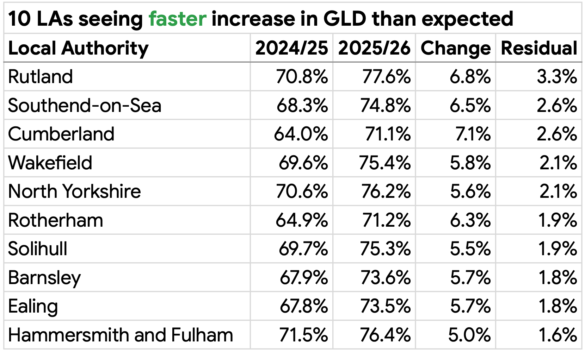
To be clear: this analysis is based on a simple look at the data. When I’m talking about ‘better than expected’ and ‘more modest than expected’ increases in GLD at LA level, I’m basing this purely on distance from the trendline of all LAs. But looking at the heterogeneity of both lists of authorities – rural and urban, small unitaries and large counties, low and high deprivation – suggests there’s not a single contextual explanation to ‘wave away’ why some LAs are moving towards their GLD targets faster than expected and others are getting there more slowly.
The difference may instead be down to factors that fall within the control of LAs and local early years partnerships: strategic decisions about which programmes and services to commission; the way data is being used to evaluate and target interventions; the clarity of identification and support pathways for young people with additional needs; the degree of integration between different elements of the early years system, and relationships with families.
Given the diminishing window for action before summer 2028, we may want to learn as much as we can from this year’s outliers.